English Pronunciation Guide: 48 Essential Sound Patterns
Pronunciation is the layer most textbooks skip. This guide covers the 48 patterns that cause the most difficulty for learners worldwide — from tricky vowels and silent letters to the connected-speech reductions that make native speakers hard to follow. Search and filter below.
48 sound patterns · 6 categories
"/æ/ — "cat", "map", "black""
Low front vowel: jaw drops, tongue stays forward and low. Absent in most languages. Distinct from /ɑː/ in "father" and /ɛ/ in "bed".
""The man packed a black bag." — every "a" is /æ/."
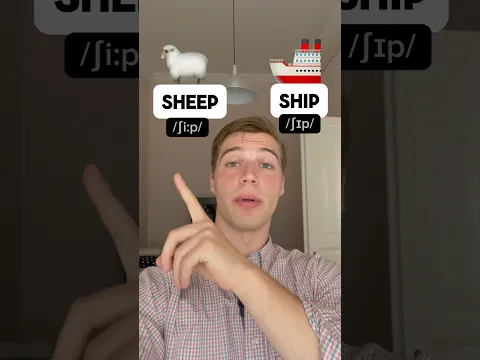
"/ɪ/ vs /iː/ — "ship" vs "sheep""
/ɪ/ is short and lax; /iː/ is long and tense. Confusing them changes meaning: "He lives on a ship / sheep."
""I want to live (lɪv) here and truly live (liːv) my life.""
"/ʌ/ — "cup", "love", "run""
Mid-central vowel. Russian speakers often replace it with /a/, Spanish speakers with /o/. Keep the mouth half-open and tongue neutral.
""The young son won the fun run." — all underlined vowels are /ʌ/."
"/ɜː/ — "bird", "word", "turn""
This "er" sound does not exist in most other languages. Raise the mid tongue slightly; lips are neither spread nor rounded.
""Her first nurse earned a birthday reward.""
"/ə/ — schwa in "about", "banana""
The most common English vowel — every unstressed syllable can reduce to schwa. Over-pronouncing unstressed vowels is a leading cause of a heavy accent.
""A banana is a common example of schwa." — every "a" is /ə/."
"/eɪ/ — "face", "day", "they""
A diphthong that glides from /e/ to /ɪ/. Many languages use a pure /e/ here; adding the glide makes it sound noticeably more natural.
""They say the grey waves change shape every day.""
"/ʊ/ vs /uː/ — "foot" vs "food""
/ʊ/ is short and lax; /uː/ is long and tense. Many learners use /uː/ for both, turning "full" into "fool".
""The cook took a good look at the moon over the pool.""
"/ɒ/ vs /oʊ/ — "not" vs "note""
British /ɒ/ is a short open vowel; American /ɑː/ is more back. /oʊ/ is a diphthong. Mixing them shifts meanings dramatically.
""I wrote a note, not a knot, on the dotted lot.""
"/θ/ vs /ð/ — "think" vs "this""
/θ/ is voiceless (think, three, both); /ð/ is voiced (this, that, breathe). Tongue tip rests lightly between the teeth. Absent in Russian, Japanese, most Romance languages.
""Breathe through your teeth, not through your nose." — both "th" types appear."
"/r/ — "red", "great", "train""
English /r/ is retroflex or bunched; the tongue never touches the roof of the mouth. Spanish speakers trill it; Japanese learners approximate it with /l/ or /ɾ/.
""The right road runs around the rear of the river.""
"Clear /l/ vs dark /ɫ/ — "leaf" vs "feel""
Clear /l/ before vowels; dark /ɫ/ after vowels. In dark /l/ the back of the tongue rises toward the soft palate. Many learners use only one variant.
""I still feel the pull of the local village hills.""
"/v/ vs /w/ — "very" vs "worry""
/v/ requires the upper teeth to touch the lower lip; /w/ uses rounded lips only. German, Japanese, and some Spanish speakers often confuse these.
""The very wet weather was worse than we expected.""
"/p/ /t/ /k/ aspiration at syllable onset"
At the start of a stressed syllable, English stops are aspirated — a puff of air follows. "Pin" [pʰɪn] vs "spin" [spɪn]. Missing aspiration makes speech sound flat.
""Please tell Kevin to keep the top cup clean.""
"/ŋ/ — "sing", "running", "-ing""
Velar nasal: back of tongue touches the soft palate. In "-ing" endings the /g/ is silent. Many learners add a /g/ at the end: "singk-ing" instead of "sing-ing".
""Running, singing, and jumping are amazing things.""
"/dʒ/ vs /ʒ/ — "jump" vs "measure""
/dʒ/ is an affricate (hard "j"); /ʒ/ is a fricative (as in "measure", "vision", "beige"). Both are rare in many learner languages.
""The judge measured the vision of the beige garage.""
"/h/ — "hat", "behind", "perhaps""
Voiceless glottal fricative. Spanish, French, and Portuguese speakers often drop /h/ because it is silent in their languages.
""He had hardly heard of her half-hearted habit.""
"Silent "k" — "know", "knee", "knock""
Before "n", the letter "k" is always silent: know, knock, knee, knight, knit, knob, knack, kneel.
""The knight knelt and knocked his knuckle on the knob.""
"Silent "w" — "write", "wrong", "wrap""
"w" is silent before "r" at the start of a word: write, wrong, wrap, wrist, wreck, wrestle, wren, wrinkle.
""She wrote the wrong answer on her wrist.""
"Silent "b" — "comb", "lamb", "thumb""
"b" is silent after "m" at the end of a word: comb, lamb, bomb, climb, thumb, dumb, crumb, numb, womb.
""The dumb climber combed crumbs off the lamb.""
"Silent "gh" — "night", "though", "caught""
"gh" is usually silent in the middle or end of words: night, light, though, through, daughter, caught, taught, enough, weight.
""Though the night was rough, they fought through to the light.""
"Silent "e" — "make", "hope", "bite""
Final silent "e" lengthens the preceding vowel: mad → made, hop → hope, bit → bite, can → cane. This is the "magic e" (CVCe) rule.
""Take the ripe grape and place it in the crate.""
"Silent "t" — "castle", "listen", "often""
"t" is silent in words ending "-stle" or "-sten": castle, whistle, listen, often, fasten, glisten, hustle, bustle, rustle.
""Listen carefully as she fastens the rustle near the castle.""
"Silent "l" — "walk", "half", "could""
"l" is silent before certain consonants: walk, talk, could, would, should, half, calm, palm, folk, yolk, salmon.
""He could walk calmly and talk with half the folk by the palm.""
"Silent "p" — "psychology", "pneumonia""
"p" is silent at the start of Greek-origin words beginning "ps-" or "pn-": psychology, psychiatry, pneumonia, pterodactyl, psalm, psyche.
""The psychiatrist treated pneumonia with a psychological approach.""
"Noun vs verb: "REcord" / "reCORD""
Many English noun/verb pairs shift stress: REcord (n) vs reCORD (v); PROtest / proTEST; PREsent / preSENT; PERmit / perMIT; OBject / obJECT.
""Please reCORD the new REcord on the official PERmit form to PERmit access.""
"Two-syllable nouns stress first syllable"
Most two-syllable nouns and adjectives carry stress on syllable 1: TAble, MOney, PEOple, HAPpy, CLEver, DOctor, SISter, WINdow.
""The CLEver DOctor placed the TAble by the WINdow.""
""-tion" / "-sion" words: stress before suffix"
Words ending in "-tion" or "-sion" always stress the syllable immediately before the suffix: comMUnication, proDUCtion, deCIsion, disCUSSion.
""The comMUnication about the deCIsion caused disCUSSion.""
"Compound nouns: stress first element"
Compound nouns stress the first element: BLACKbird, TOOTHbrush, FOOTball, SUNflower. Compare "black BIRD" (adjective + noun) where the noun is stressed.
""She left her TOOTHbrush and READing glasses on the WINDOWsill.""
"Stress shift with "-ic": PHOtograph → photoGRAPHic"
Adding "-ic" shifts stress to the syllable before it. PHOtograph → phoTOgraphy → photoGRAPHic. The word's shape changes dramatically across the family.
""The phoTOgrapher took a photoGRAPHic image for the geoGRAPHical journal.""
"Content words vs function words"
Nouns, main verbs, adjectives, and adverbs carry sentence stress. Articles, prepositions, and conjunctions are reduced and unstressed.
""She BOUGHT a BOOK for her FRIEND." — "a" and "for" reduce to /ə/ and /fər/."
"Numbers: "thirTEEN" vs "THIRty""
Numbers 13–19 stress the second syllable (thirTEEN, fourTEEN); tens stress the first (THIRty, FORty). Confusing these causes real misunderstandings in prices and dates.
""I paid THIRty dollars — not thirTEEN, and definitely not fourTEEN.""
"-ate verbs vs nouns: creATE vs CLImate"
Two-syllable "-ate" verbs stress the second syllable (creATE, doNATE); nouns and adjectives stress the first with a reduced ending (CLImate /ɪt/, DELicate).
""The deliCATE delegate must deliVER and deliBERate carefully.""
"Linking: consonant → vowel"
When a word ends in a consonant and the next begins with a vowel, the sounds link: "turn it off" → "tur-ni-toff"; "come on in" → "cu-mo-nin".
""Pick it up" → "pi-ki-tup"; "check it out" → "che-ki-tout"."
"Intrusive /r/ — "saw it" → "saw-rit""
In non-rhotic British English, a /r/ is inserted when a vowel-final word is followed by another vowel: "law and order" → "law-rand-order"; "idea of" → "idea-rof".
""The media is covering the area in Africa." — /r/ links at each vowel junction."
"Elision: dropping sounds in clusters"
"Next day" → "nex day", "asked him" → "ast him", "most people" → "mos people". The /t/ and /d/ are most often elided between consonants in fast speech.
""He must have asked the last person on the list." — multiple /t/ sounds are dropped."
"Assimilation: sounds change for neighbours"
A sound takes on properties of the sound next to it: "ten people" → "tem people"; "that person" → "thap person". The nasal or stop assimilates to the following consonant.
""In practice" → "im practice"; "good boy" → "goob boy"."
"Weak forms of function words"
"can" → /kən/; "and" → /ən/ or /n/; "to" → /tə/; "for" → /fər/; "of" → /əv/; "them" → /ðəm/ → /əm/. The strong forms appear only under emphasis.
""I can go and meet her for a cup of tea." — every function word is in weak form."
"Flapping: American /t/ and /d/ between vowels"
In American English, /t/ or /d/ between vowels becomes a flap /ɾ/ (a quick "d"): "water" → "wa-der", "better" → "be-der", "city" → "si-dy".
""I got a little butter on my data." — all four consonants are flapped in AmE."
"Contractions: gonna, wanna, gotta"
"Gonna" = going to; "wanna" = want to; "gotta" = got to; "kinda" = kind of; "hafta" = have to; "dunno" = don't know. These are normal fast-speech reductions, not slang.
""I'm gonna hafta kinda think about it, I dunno." — fully natural in conversation."
"Consonant cluster simplification"
When three or more consonants cluster, one is dropped: "friendship" → "fren-ship", "handsome" → "han-some", "sandwich" → "sam-wich".
""He asked the handsome stranger for a sandwich at the campsite.""
"Falling intonation: statements & wh-questions"
Declarative sentences and wh-questions end with a falling tone. A falling tone signals certainty and completion. Rising at the end of a statement sounds like a question.
""She works at the hospital↘." / "Where do you live↘?""
"Rising intonation: yes/no questions"
Yes/no questions typically end with a rising tone, signalling that an answer is expected. The rise starts on the last stressed syllable.
""Are you coming↗?" / "Did she call↗?" / "Is it ready↗?""
"Fall-rise: politeness and reservation"
The fall-rise tone (falling then rising on the same syllable) signals reservation, implying "yes, but…". It is widely used in polite British English.
""I suppose↘↗ we could try." (implies doubt or hesitation)"
"Intonation for lists"
In a list, all items except the last carry a rising tone; the final item falls: "I need milk↗, eggs↗, butter↗, and bread↘."
""She speaks French↗, Spanish↗, Italian↗, and Japanese↘.""
"Contrastive stress"
Shifting stress to different words changes meaning: "I didn't say HE stole it" (someone else did) vs "I didn't SAY he stole it" (I implied it).
""I never said SHE stole the money." (six different meanings with six stress positions)"
"Stress timing vs syllable timing"
English compresses unstressed syllables between stresses ("stress-timed"). Spanish and Japanese give each syllable equal duration ("syllable-timed"). Matching English rhythm requires this compression.
""The MAN on the LEFT of the ROOM" — "on the" and "of the" are rushed."
"Thought groups and pausing"
Native speakers divide speech into thought groups (short breath groups of 3–6 words). Pausing at the wrong place disrupts the listener's parsing of meaning.
""The teacher said // the student was wrong" vs "The teacher, said the student, // was wrong.""
"Tones in tag questions"
Tag questions with a rising tone are genuine questions; a falling tone confirms shared information: "It's cold today, isn't it↘?" (confirmation) vs "isn't it↗?" (asking).
""You've met her before, haven't you↘?" — expects agreement."
Frequently Asked Questions
How long does it take to improve English pronunciation?
Most learners notice significant improvement within 3–6 months of focused listening practice. The key is massive exposure to comprehensible input — not isolated drilling. Your brain recalibrates its phoneme categories when you hear enough real speech at the right level.
Should I learn IPA (International Phonetic Alphabet)?
You do not need to memorise the entire IPA, but knowing the 20 or so symbols for English phonemes is highly useful. It lets you read any dictionary entry, understand pronunciation guides, and communicate precisely about sounds. Invest one focused hour — it pays off for years.
What is the most common English pronunciation mistake?
Incorrect word stress. Unlike Spanish, Italian, or Japanese — where stress is relatively predictable — English stress placement is lexical (stored per word). Misplaced stress disrupts intelligibility more than any single mispronounced consonant or vowel.
Is it possible to lose my accent completely?
For adults, a completely accent-free accent is rare. But that is not the goal. The goal is to be fully intelligible and to understand native speakers easily. Many successful bilinguals retain a slight accent while communicating flawlessly. Focus on reducing the patterns that cause misunderstanding.
How can I practise English pronunciation at home?
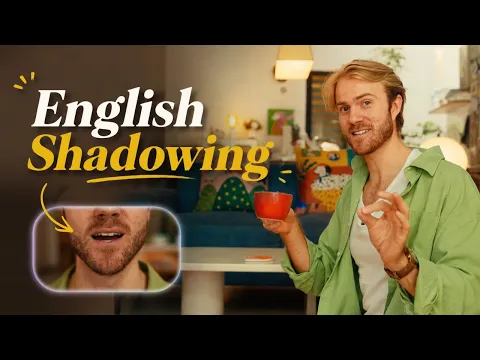
The most effective home method is extensive listening to authentic English content — series, podcasts, YouTube — at a level where you understand 80–95% already. Shadowing (repeating aloud slightly after the speaker) is a powerful technique. Recording yourself and comparing to the original also accelerates progress significantly.
The fastest way to internalise pronunciation is hearing real English in context — not drilling isolated sounds.
Practice with real English videos →