Pronunciación inglesa: 48 patrones de sonido esenciales
La pronunciación es la capa del inglés que la mayoría de los libros de texto omite. Esta guía cubre los 48 patrones que más dificultades causan a los estudiantes de todo el mundo: desde vocales complicadas y letras mudas hasta las reducciones del habla conectada que hacen difícil seguir a los hablantes nativos. Usa la búsqueda y el filtro a continuación.
48 sound patterns · 6 categories
"/æ/ — "cat", "map", "black""
Low front vowel: jaw drops, tongue stays forward and low. Absent in most languages. Distinct from /ɑː/ in "father" and /ɛ/ in "bed".
""The man packed a black bag." — every "a" is /æ/."
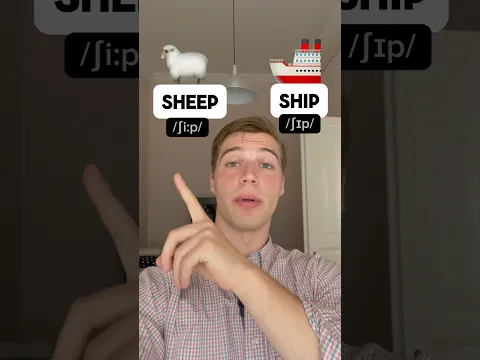
"/ɪ/ vs /iː/ — "ship" vs "sheep""
/ɪ/ is short and lax; /iː/ is long and tense. Confusing them changes meaning: "He lives on a ship / sheep."
""I want to live (lɪv) here and truly live (liːv) my life.""
"/ʌ/ — "cup", "love", "run""
Mid-central vowel. Russian speakers often replace it with /a/, Spanish speakers with /o/. Keep the mouth half-open and tongue neutral.
""The young son won the fun run." — all underlined vowels are /ʌ/."
"/ɜː/ — "bird", "word", "turn""
This "er" sound does not exist in most other languages. Raise the mid tongue slightly; lips are neither spread nor rounded.
""Her first nurse earned a birthday reward.""
"/ə/ — schwa in "about", "banana""
The most common English vowel — every unstressed syllable can reduce to schwa. Over-pronouncing unstressed vowels is a leading cause of a heavy accent.
""A banana is a common example of schwa." — every "a" is /ə/."
"/eɪ/ — "face", "day", "they""
A diphthong that glides from /e/ to /ɪ/. Many languages use a pure /e/ here; adding the glide makes it sound noticeably more natural.
""They say the grey waves change shape every day.""
"/ʊ/ vs /uː/ — "foot" vs "food""
/ʊ/ is short and lax; /uː/ is long and tense. Many learners use /uː/ for both, turning "full" into "fool".
""The cook took a good look at the moon over the pool.""
"/ɒ/ vs /oʊ/ — "not" vs "note""
British /ɒ/ is a short open vowel; American /ɑː/ is more back. /oʊ/ is a diphthong. Mixing them shifts meanings dramatically.
""I wrote a note, not a knot, on the dotted lot.""
"/θ/ vs /ð/ — "think" vs "this""
/θ/ is voiceless (think, three, both); /ð/ is voiced (this, that, breathe). Tongue tip rests lightly between the teeth. Absent in Russian, Japanese, most Romance languages.
""Breathe through your teeth, not through your nose." — both "th" types appear."
"/r/ — "red", "great", "train""
English /r/ is retroflex or bunched; the tongue never touches the roof of the mouth. Spanish speakers trill it; Japanese learners approximate it with /l/ or /ɾ/.
""The right road runs around the rear of the river.""
"Clear /l/ vs dark /ɫ/ — "leaf" vs "feel""
Clear /l/ before vowels; dark /ɫ/ after vowels. In dark /l/ the back of the tongue rises toward the soft palate. Many learners use only one variant.
""I still feel the pull of the local village hills.""
"/v/ vs /w/ — "very" vs "worry""
/v/ requires the upper teeth to touch the lower lip; /w/ uses rounded lips only. German, Japanese, and some Spanish speakers often confuse these.
""The very wet weather was worse than we expected.""
"/p/ /t/ /k/ aspiration at syllable onset"
At the start of a stressed syllable, English stops are aspirated — a puff of air follows. "Pin" [pʰɪn] vs "spin" [spɪn]. Missing aspiration makes speech sound flat.
""Please tell Kevin to keep the top cup clean.""
"/ŋ/ — "sing", "running", "-ing""
Velar nasal: back of tongue touches the soft palate. In "-ing" endings the /g/ is silent. Many learners add a /g/ at the end: "singk-ing" instead of "sing-ing".
""Running, singing, and jumping are amazing things.""
"/dʒ/ vs /ʒ/ — "jump" vs "measure""
/dʒ/ is an affricate (hard "j"); /ʒ/ is a fricative (as in "measure", "vision", "beige"). Both are rare in many learner languages.
""The judge measured the vision of the beige garage.""
"/h/ — "hat", "behind", "perhaps""
Voiceless glottal fricative. Spanish, French, and Portuguese speakers often drop /h/ because it is silent in their languages.
""He had hardly heard of her half-hearted habit.""
"Silent "k" — "know", "knee", "knock""
Before "n", the letter "k" is always silent: know, knock, knee, knight, knit, knob, knack, kneel.
""The knight knelt and knocked his knuckle on the knob.""
"Silent "w" — "write", "wrong", "wrap""
"w" is silent before "r" at the start of a word: write, wrong, wrap, wrist, wreck, wrestle, wren, wrinkle.
""She wrote the wrong answer on her wrist.""
"Silent "b" — "comb", "lamb", "thumb""
"b" is silent after "m" at the end of a word: comb, lamb, bomb, climb, thumb, dumb, crumb, numb, womb.
""The dumb climber combed crumbs off the lamb.""
"Silent "gh" — "night", "though", "caught""
"gh" is usually silent in the middle or end of words: night, light, though, through, daughter, caught, taught, enough, weight.
""Though the night was rough, they fought through to the light.""
"Silent "e" — "make", "hope", "bite""
Final silent "e" lengthens the preceding vowel: mad → made, hop → hope, bit → bite, can → cane. This is the "magic e" (CVCe) rule.
""Take the ripe grape and place it in the crate.""
"Silent "t" — "castle", "listen", "often""
"t" is silent in words ending "-stle" or "-sten": castle, whistle, listen, often, fasten, glisten, hustle, bustle, rustle.
""Listen carefully as she fastens the rustle near the castle.""
"Silent "l" — "walk", "half", "could""
"l" is silent before certain consonants: walk, talk, could, would, should, half, calm, palm, folk, yolk, salmon.
""He could walk calmly and talk with half the folk by the palm.""
"Silent "p" — "psychology", "pneumonia""
"p" is silent at the start of Greek-origin words beginning "ps-" or "pn-": psychology, psychiatry, pneumonia, pterodactyl, psalm, psyche.
""The psychiatrist treated pneumonia with a psychological approach.""
"Noun vs verb: "REcord" / "reCORD""
Many English noun/verb pairs shift stress: REcord (n) vs reCORD (v); PROtest / proTEST; PREsent / preSENT; PERmit / perMIT; OBject / obJECT.
""Please reCORD the new REcord on the official PERmit form to PERmit access.""
"Two-syllable nouns stress first syllable"
Most two-syllable nouns and adjectives carry stress on syllable 1: TAble, MOney, PEOple, HAPpy, CLEver, DOctor, SISter, WINdow.
""The CLEver DOctor placed the TAble by the WINdow.""
""-tion" / "-sion" words: stress before suffix"
Words ending in "-tion" or "-sion" always stress the syllable immediately before the suffix: comMUnication, proDUCtion, deCIsion, disCUSSion.
""The comMUnication about the deCIsion caused disCUSSion.""
"Compound nouns: stress first element"
Compound nouns stress the first element: BLACKbird, TOOTHbrush, FOOTball, SUNflower. Compare "black BIRD" (adjective + noun) where the noun is stressed.
""She left her TOOTHbrush and READing glasses on the WINDOWsill.""
"Stress shift with "-ic": PHOtograph → photoGRAPHic"
Adding "-ic" shifts stress to the syllable before it. PHOtograph → phoTOgraphy → photoGRAPHic. The word's shape changes dramatically across the family.
""The phoTOgrapher took a photoGRAPHic image for the geoGRAPHical journal.""
"Content words vs function words"
Nouns, main verbs, adjectives, and adverbs carry sentence stress. Articles, prepositions, and conjunctions are reduced and unstressed.
""She BOUGHT a BOOK for her FRIEND." — "a" and "for" reduce to /ə/ and /fər/."
"Numbers: "thirTEEN" vs "THIRty""
Numbers 13–19 stress the second syllable (thirTEEN, fourTEEN); tens stress the first (THIRty, FORty). Confusing these causes real misunderstandings in prices and dates.
""I paid THIRty dollars — not thirTEEN, and definitely not fourTEEN.""
"-ate verbs vs nouns: creATE vs CLImate"
Two-syllable "-ate" verbs stress the second syllable (creATE, doNATE); nouns and adjectives stress the first with a reduced ending (CLImate /ɪt/, DELicate).
""The deliCATE delegate must deliVER and deliBERate carefully.""
"Linking: consonant → vowel"
When a word ends in a consonant and the next begins with a vowel, the sounds link: "turn it off" → "tur-ni-toff"; "come on in" → "cu-mo-nin".
""Pick it up" → "pi-ki-tup"; "check it out" → "che-ki-tout"."
"Intrusive /r/ — "saw it" → "saw-rit""
In non-rhotic British English, a /r/ is inserted when a vowel-final word is followed by another vowel: "law and order" → "law-rand-order"; "idea of" → "idea-rof".
""The media is covering the area in Africa." — /r/ links at each vowel junction."
"Elision: dropping sounds in clusters"
"Next day" → "nex day", "asked him" → "ast him", "most people" → "mos people". The /t/ and /d/ are most often elided between consonants in fast speech.
""He must have asked the last person on the list." — multiple /t/ sounds are dropped."
"Assimilation: sounds change for neighbours"
A sound takes on properties of the sound next to it: "ten people" → "tem people"; "that person" → "thap person". The nasal or stop assimilates to the following consonant.
""In practice" → "im practice"; "good boy" → "goob boy"."
"Weak forms of function words"
"can" → /kən/; "and" → /ən/ or /n/; "to" → /tə/; "for" → /fər/; "of" → /əv/; "them" → /ðəm/ → /əm/. The strong forms appear only under emphasis.
""I can go and meet her for a cup of tea." — every function word is in weak form."
"Flapping: American /t/ and /d/ between vowels"
In American English, /t/ or /d/ between vowels becomes a flap /ɾ/ (a quick "d"): "water" → "wa-der", "better" → "be-der", "city" → "si-dy".
""I got a little butter on my data." — all four consonants are flapped in AmE."
"Contractions: gonna, wanna, gotta"
"Gonna" = going to; "wanna" = want to; "gotta" = got to; "kinda" = kind of; "hafta" = have to; "dunno" = don't know. These are normal fast-speech reductions, not slang.
""I'm gonna hafta kinda think about it, I dunno." — fully natural in conversation."
"Consonant cluster simplification"
When three or more consonants cluster, one is dropped: "friendship" → "fren-ship", "handsome" → "han-some", "sandwich" → "sam-wich".
""He asked the handsome stranger for a sandwich at the campsite.""
"Falling intonation: statements & wh-questions"
Declarative sentences and wh-questions end with a falling tone. A falling tone signals certainty and completion. Rising at the end of a statement sounds like a question.
""She works at the hospital↘." / "Where do you live↘?""
"Rising intonation: yes/no questions"
Yes/no questions typically end with a rising tone, signalling that an answer is expected. The rise starts on the last stressed syllable.
""Are you coming↗?" / "Did she call↗?" / "Is it ready↗?""
"Fall-rise: politeness and reservation"
The fall-rise tone (falling then rising on the same syllable) signals reservation, implying "yes, but…". It is widely used in polite British English.
""I suppose↘↗ we could try." (implies doubt or hesitation)"
"Intonation for lists"
In a list, all items except the last carry a rising tone; the final item falls: "I need milk↗, eggs↗, butter↗, and bread↘."
""She speaks French↗, Spanish↗, Italian↗, and Japanese↘.""
"Contrastive stress"
Shifting stress to different words changes meaning: "I didn't say HE stole it" (someone else did) vs "I didn't SAY he stole it" (I implied it).
""I never said SHE stole the money." (six different meanings with six stress positions)"
"Stress timing vs syllable timing"
English compresses unstressed syllables between stresses ("stress-timed"). Spanish and Japanese give each syllable equal duration ("syllable-timed"). Matching English rhythm requires this compression.
""The MAN on the LEFT of the ROOM" — "on the" and "of the" are rushed."
"Thought groups and pausing"
Native speakers divide speech into thought groups (short breath groups of 3–6 words). Pausing at the wrong place disrupts the listener's parsing of meaning.
""The teacher said // the student was wrong" vs "The teacher, said the student, // was wrong.""
"Tones in tag questions"
Tag questions with a rising tone are genuine questions; a falling tone confirms shared information: "It's cold today, isn't it↘?" (confirmation) vs "isn't it↗?" (asking).
""You've met her before, haven't you↘?" — expects agreement."
Preguntas frecuentes
¿Cuánto tiempo se tarda en mejorar la pronunciación del inglés?
La mayoría de los estudiantes notan una mejora significativa en 3–6 meses de práctica de escucha enfocada. La clave es la exposición masiva a input comprensible, no la práctica aislada de sonidos. El cerebro recalibra sus categorías fonémicas al escuchar suficiente habla real al nivel adecuado.
¿Debo aprender el AFI (Alfabeto Fonético Internacional)?
No necesitas memorizar todo el AFI, pero conocer los cerca de 20 símbolos para los fonemas del inglés es muy útil. Te permite leer cualquier entrada de diccionario, entender guías de pronunciación y comunicarte con precisión sobre los sonidos. Invierte una hora — rinde frutos durante años.
¿Cuál es el error de pronunciación más común en inglés?
El acento de palabra incorrecto. A diferencia del español, italiano o japonés, donde el acento es relativamente predecible, en inglés el acento es léxico (se almacena por palabra). El acento mal colocado interrumpe la inteligibilidad más que cualquier consonante o vocal mal pronunciada.
¿Es posible perder completamente mi acento?
Para los adultos, un acento completamente neutro es poco común. Pero ese no es el objetivo. El objetivo es ser completamente inteligible y entender a los hablantes nativos con facilidad. Muchos bilingües exitosos mantienen un ligero acento mientras se comunican perfectamente. Concéntrate en reducir los patrones que causan malentendidos.
¿Cómo puedo practicar la pronunciación del inglés en casa?
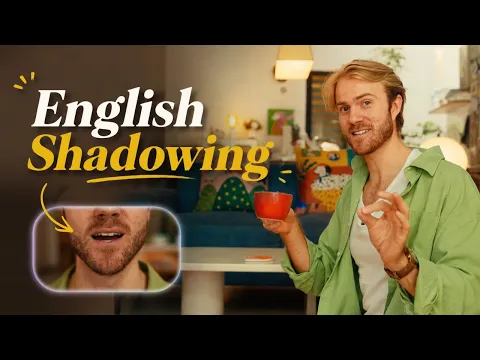
El método casero más efectivo es escuchar extensamente contenido auténtico en inglés — series, podcasts, YouTube — a un nivel donde ya entiendes el 80–95%. El shadowing (repetir en voz alta ligeramente después del hablante) es una técnica poderosa. Grabarse y comparar con el original también acelera el progreso.
La forma más rápida de internalizar la pronunciación es escuchar inglés real en contexto, no practicar sonidos aislados.
Practica con videos reales →